

You have been strong for so long that survival started to feel like living. It is not the same thing.
There is a version of okay that is not okay at all.
It functions. It shows up. It meets deadlines and keeps appointments and remembers everyone's birthdays and manages the household and holds down the job and checks in on aging parents and makes sure the children are fed and the bills are paid. It does all of this without complaint, without visible strain, without asking for anything in return.
From the outside, it looks like a woman who has it together. From the inside, it feels like running on a fuel source that was supposed to be temporary and somehow became permanent.
That is survival. And for many Black women over 40, it has been the primary mode of operation for so long that it stopped feeling like a coping mechanism and started feeling like a personality.
Understanding the difference between surviving vs healing as a Black woman is not an academic exercise. It is the question that determines whether the next decade of your life looks like the last two, or whether something genuinely different becomes possible. If you have ever wondered what emotional healing actually looks like in practice, what does emotional healing actually look like for a Black woman who has never prioritized herself is where that question gets answered honestly.
This post is about the distinction itself. Because you cannot choose healing if you do not know the difference between what you have been doing and what healing actually requires.
What Surviving Actually Looks Like and Why So Many Black Women Are Stuck Here
Survival mode does not look like what most people imagine when they hear the phrase.
It does not look like crisis. It does not look like falling apart or struggling visibly or asking for help. For Black women, survival mode almost always looks like competence. Like reliability. Like being the one everyone can count on.
Black women healing vs coping begins with understanding that coping is sophisticated. It is not weakness dressed up as strength. It is a genuinely intelligent response to an environment that required you to keep moving regardless of what was happening inside you. Your nervous system learned, probably very early, that there was no space for you to stop. That the consequences of stopping, of needing, of falling apart even briefly, were too costly. So it adapted. It built systems. It developed the capacity to compartmentalize pain so efficiently that you could carry significant emotional weight without anyone around you ever knowing it was there.
That adaptation kept you safe. It kept your family intact. It kept your career on track. It allowed you to function through grief, through disappointment, through the slow erosion of your own needs, through experiences that would have stopped other people in their tracks.
The problem is not that you developed these survival skills. The problem is that survival mode was designed for emergencies and you have been living in it continuously for twenty or thirty years. What was meant to be a temporary override has become the default setting. And the cost of running on emergency power for that long is enormous, even when the bill does not arrive all at once.
Survival looks like going through the motions of a full life while feeling strangely absent from it. It looks like numbness that you have learned to call being fine. It looks like a low-level exhaustion that sleep does not fix because the exhaustion is not physical, it is existential. It looks like functioning beautifully on the outside while quietly wondering, somewhere underneath all the functioning, if this is really all there is.
What Real Healing Looks Like and Why It Feels Terrifying
If survival is the emergency system, healing is the process of returning the body and the spirit to their natural operating state. And the difference between healing and surviving is not simply a matter of feeling better. It is a fundamentally different orientation toward yourself and your own interior life.
Healing requires presence. Survival requires management. That is the core distinction, and it is why healing feels so threatening to women who have become expert managers.
When you are surviving, your relationship to your own pain is primarily administrative. You contain it, you schedule it, you make sure it does not interfere with your output. You have become so skilled at this that you may not even experience the pain consciously anymore. It lives in your body as tension, as insomnia, as a short fuse about small things, as the particular flatness that settles in on Sunday evenings. But you have learned to route around it so efficiently that you rarely have to look at it directly.
Healing asks you to look at it directly. To stop routing around it and instead turn toward it. To be present with what is actually there instead of managing it into silence.
That is terrifying for a specific reason: survival mode is, among other things, a form of control. You know how to manage. You know how to function. You know what to expect from yourself when you are in survival mode because you have been there so long. Healing, by contrast, requires you to enter territory where you do not know what you will find, where the outcome is not guaranteed, where the process is not linear, and where the primary skill required is not strength but willingness.
For a woman whose entire identity has been built around strength, willingness can feel like the hardest thing in the world.
Are you tired of being the strong one?
You have been in survival mode for a long time. This free workbook was written for the moment you are ready to try something different.
Download your free healing workbook - I Am So Tired of Being Strong
A 5-page healing workbook for Black women over 40 who are ready to stop coping and start actually healing.
The Moment the Shift Happens From Surviving to Healing
The shift from surviving to healing is rarely a decision in the conventional sense. It is rarely a moment where you sit down, weigh the options, and choose healing the way you might choose a new direction at work.
More often, the shift in the surviving vs healing journey for Black women happens because survival stops working.
Not all at once. Not dramatically. But there comes a point, for many women in their forties and fifties, where the coping mechanisms that carried them through the previous decades begin to lose their effectiveness. The compartmentalization starts to leak. The numbness becomes harder to maintain. The exhaustion exceeds the capacity to manage it. The body begins to register what the mind has been refusing to acknowledge.
This is not a breakdown. It is a signal. The system that kept you safe is telling you that it was not designed for permanent use, and that the cost of continuing to run on it is now higher than the cost of doing something different.
Sometimes the shift is triggered by a specific event. A health scare. A loss. A milestone birthday that arrives with unexpected weight. A relationship that ends or changes in ways that cannot be absorbed by the usual coping systems. Sometimes it is triggered by nothing external at all, just a quiet internal recognition that arrives sideways on an ordinary morning: I cannot keep doing this exactly as I have been doing it.
That recognition, however it arrives, is the doorway. You do not have to know what comes next. You do not have to have a plan. You just have to be willing to stand in the doorway for long enough to consider walking through it.
Why Black Women Stay in Survival Mode Longer Than They Should
Understanding why Black women over 40 healing often gets delayed is not about assigning blame. It is about removing the shame that keeps so many women from recognizing what is actually happening to them.
Black women stay in survival mode longer than they should for reasons that are structural, cultural, and deeply relational, and none of those reasons are character flaws.
Structurally, many Black women simply do not have the luxury of stopping. The economic realities, the caregiving responsibilities, the professional demands, the absence of adequate support systems , these are not imagined obstacles. They are real constraints that make the sustained attention that healing requires genuinely difficult to access.
Culturally, the Strong Black Woman framework actively penalizes the expression of need. It rewards endurance. It treats vulnerability as risk. It has been so thoroughly internalized by so many Black women that they no longer experience it as an external message but as a core belief about who they are and what they are supposed to be capable of handling.
Relationally, survival mode often serves the people around you in ways that healing does not. When you are in survival mode, you are maximally available. Maximally functional. Maximally oriented toward everyone else's needs. Healing asks you to redirect some of that orientation toward yourself, and the people who have benefited from your survival mode may not welcome that redirection, even unconsciously.
And finally, many Black women stay in survival mode simply because they have never been shown what the alternative looks like. If every woman you grew up watching was also surviving, if the models available to you were all models of endurance rather than restoration, then healing can feel not just difficult but genuinely foreign. Like something other people do. Something you were not quite built for.
You were built for it. It just was not modeled for you. And the 7 stages of emotional healing every Black woman goes through exist precisely to give you the map that was never handed to you.
How to Choose Healing Even When Survival Has Kept You Safe
Choosing healing when survival has been your primary operating system for decades is not a matter of motivation or willpower. It is a matter of building, slowly and with intention, the conditions that make healing possible.
This begins with permission. The explicit, private, non-negotiable decision that you are allowed to heal. Not when everyone else is okay. Not when your responsibilities are lighter. Not when you have earned it through sufficient suffering or sufficient service. Now. As you are. With everything still unresolved and everyone still needing things from you.
It continues with honesty. Honest acknowledgment of what surviving has cost you. Not to generate guilt or grief, though both may arise, but to make the cost visible enough that the choice to do something different becomes real rather than theoretical.
It builds through small, consistent acts of turning toward yourself. The emotional healing for Black women over 40 does not begin with transformation. It begins with attention. Paying attention to what you feel. Paying attention to what you need. Paying attention to the places where you have been routing around your own interior life for so long that you forgot it was there.
And it is supported by tools that make the process tangible. Writing is one of the most reliable of those tools, not because writing is magic, but because the act of putting words to what is happening inside you makes it real in a way that thinking alone cannot. If you are looking for a place to begin that practice, the Afrocentric Paperback Journal gives you a beautiful, intentional space to start. Blank lined pages. No prompts telling you what to feel. Just space for whatever needs to come out.
Surviving vs healing as a Black woman ultimately comes down to this: survival asks you to be strong enough to keep going. Healing asks you to be brave enough to stop and look at what keeping going has cost you.
This is usually the moment most Black women realize they don’t need to be stronger. They need to be supported.
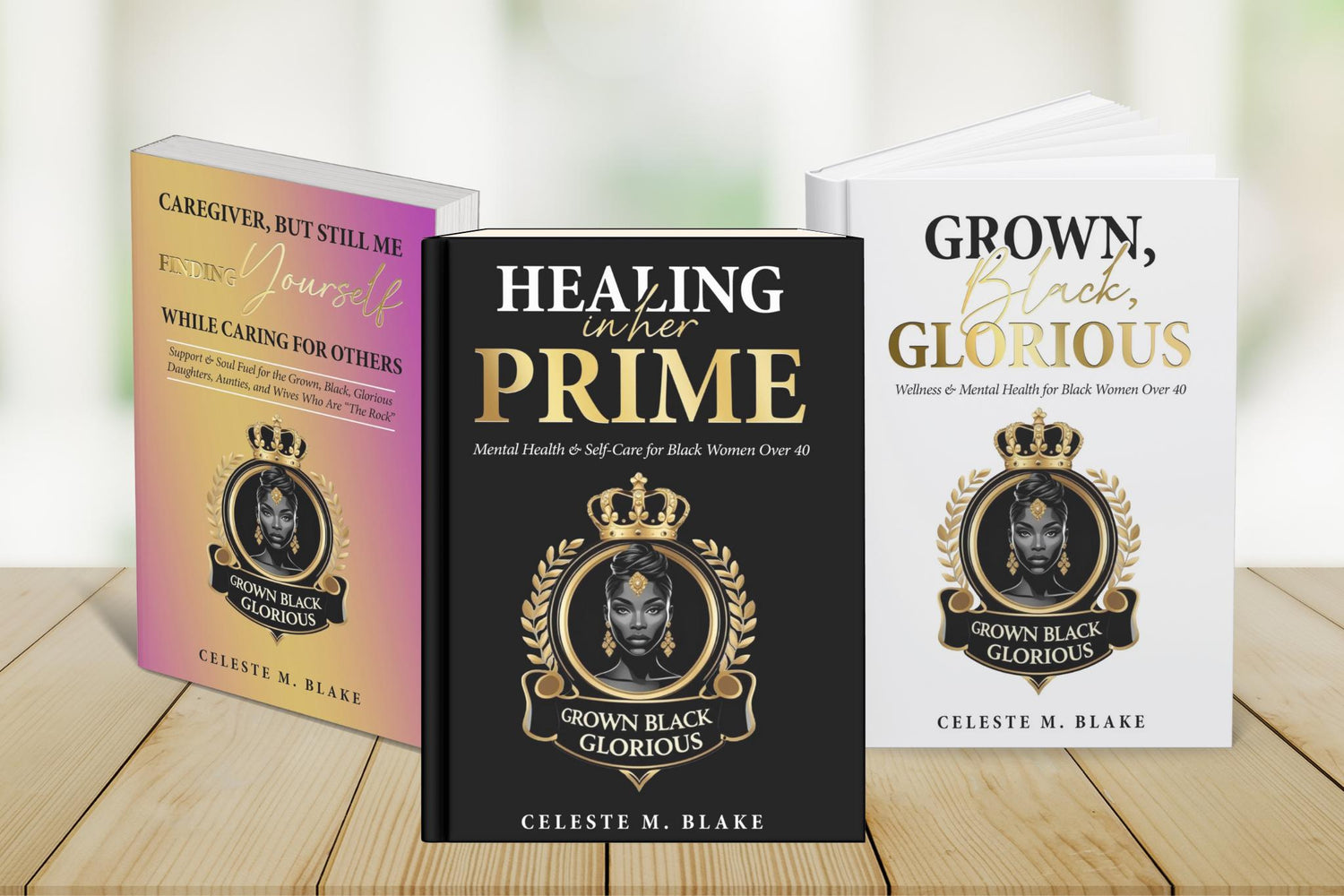
That’s exactly what Healing in Her Prime was created for.
You have already proven you are strong enough. The question now is whether you are ready to be brave enough.
If this post felt like it was written about you, the next step is not more reading, it’s starting your healing in real time. The Self-Care Journal Bundle for Black Women 40+ was built for exactly this transition, the movement from coping to actually healing, emotional burnout and reclaiming your identity, one day and one honest moment at a time. If you are ready to stop surviving and start healing, it is a gentle and powerful place to begin.
Start with the Self-Care Journal Bundle for Black Women 40+
Are you ready to stop surviving and start healing?
Download your free workbook and take the first step.
I Am So Tired of Being Strong - Download for Free
A Note Before You Go, Sis
This space was created with care, intention, and deep respect for the experiences many Black women carry. The reflections, stories, and tools shared here are offered for educational and inspirational purposes only.
They are not medical advice, psychological treatment, psychiatric care, or therapy, and they are not intended to replace the guidance of licensed professionals.
I am not a licensed medical provider, therapist, psychologist, psychiatrist, or mental health professional. The content on this site is meant to support reflection and personal growth, but it should not be used as a substitute for professional evaluation, diagnosis, or treatment.
If you are experiencing severe emotional distress, trauma, or mental health challenges, reaching out to a qualified healthcare or mental health professional is an important and supportive step. Professional care is not separate from healing, it is often a powerful part of it.
By engaging with this content, you acknowledge that it is shared for informational and inspirational purposes and that personal decisions about health, wellbeing, and care should always be made with the support of appropriate professionals when needed.
You deserve compassion, support, and every resource available to help you heal and grow.
---

With warmth and faith in your journey,