

It is the middle of the afternoon and you are in a meeting, physically present, saying the right things, nodding at the right moments. But underneath that surface, another conversation is happening entirely. You are calculating whether your mother took her medication this morning. You are tracking the fact that your youngest needs new shoes before Friday. You are composing an email in your head that you need to send before 5 p.m. You are remembering that someone's birthday is coming up and you have not gotten anything yet. You are doing three jobs at once and none of them are the one you are being paid for right now.
This is the mental load. And for Black women, it does not stop.
The mental load is not the tasks themselves. It is the constant background processing required to manage, anticipate, organize, remember, and coordinate everything across every domain of your life simultaneously. It is the part of caregiving and household management and emotional responsibility that lives in your head long after everyone else has stopped thinking about it. It is the cognitive hum that never fully goes quiet, even when your body finally goes still.
If you have been reading through this series, you already know this connects to something bigger. If this is where you are starting, the Strong Black Woman Burnout: Reclaiming Your Identity Beyond Roles will give you the full context for what we are unpacking here.
What Emotional Labor Looks Like in Daily Life
Emotional labor shows up so consistently in the daily lives of Black women that most of us have stopped recognizing it as labor at all. It just feels like life.
It is the way you automatically modulate your tone in a room where tension is rising before anyone else has registered it. The way you track the emotional states of the people around you and adjust your behavior accordingly, softening here, firming up there, reading the room in real time without anyone asking you to. The way you absorb other people's anxiety without naming it as a thing you are absorbing.
In the home, it looks like this: You are not just cooking dinner. You are remembering who does not eat what, calculating the timing so everything is ready at once, noticing that the kitchen is low on something you will need to add to the list you are keeping in your head, and managing the energy of whoever else is in the house while you do all of it. The meal gets made. Everyone eats. No one sees the orchestration behind it.
At work, it looks like this: You are not just completing your responsibilities. You are monitoring how your presence lands in rooms where you are often the only one who looks like you. You are calibrating how much space to take up, how much to push back, when to let something go because the cost of addressing it will be higher than the offense itself. You are doing your job and simultaneously managing the social and racial dynamics of the environment you are doing it in.
In relationships, it looks like this: You are the one who remembers the important dates, notices when something is off with someone you love, initiates the difficult conversations, and follows up to make sure things were actually resolved. You are the keeper of the relational memory. The one who holds the history of what has been said, what was meant, and what still needs to be addressed.
None of this is acknowledged as work. None of it appears on a resume or gets evaluated in a performance review. It just gets done, quietly, by you, because the alternative, letting it not get done, has costs that usually fall on you too.
Many women later realize that this constant anticipation and emotional coordination is closely connected to the pattern of overfunctioning, where one person gradually becomes responsible for managing everything around them. If that dynamic feels familiar, Overfunctioning: The Pattern That Leads to Burnout explores how this behavior develops and why it so often leads directly to exhaustion.
Invisible Responsibilities That Create Burnout
Burnout researchers have identified a specific pattern in high-functioning, high-responsibility individuals: the tasks that are most depleting are often the ones that are least visible. The work that no one sees is doing the most damage.
For Black women, the invisible responsibilities tend to cluster in a few specific areas worth naming directly.
Anticipatory labor. This is the work of thinking ahead. Noticing that something will become a problem before it does and taking action to prevent it. Stocking the medicine cabinet before anyone gets sick. Sending the follow-up before the ball gets dropped. Preparing for the difficult conversation before it becomes a crisis. This kind of labor prevents problems that never materialize, which means it is entirely invisible. No one knows what did not go wrong because of your foresight.
Cultural and racial navigation. Black women carry the weight of operating in spaces that were not designed for them, monitoring for bias, managing the emotional labor of racism in real time, deciding when to speak and when silence is the safer bet. This is exhausting in a way that is genuinely difficult to explain to someone who has never had to do it. It is constant, low-grade vigilance, and it uses cognitive and emotional resources that have to come from somewhere.
Kinship care and community accountability. In many Black communities, women are the connective tissue of family and community networks. You are the one who checks on the elderly relative, organizes the gathering, mediates the family conflict, and ensures that relationships stay intact across distance and disagreement. This is beautiful work and it is also unpaid, underacknowledged work that adds hours to your week and weight to your nervous system.
The management of other people's feelings about your feelings. When you do express a need, an emotion, or a limit, you often have to manage the reaction to it. Reassuring people that you are not too sensitive. Explaining yourself when directness is misread. Smoothing over discomfort that your honesty created. The labor of expressing yourself does not end with the expression. It extends through the management of everyone else's response to it.
These invisible responsibilities do not appear in conversations about workload or burnout prevention because they have no name in most organizational or therapeutic frameworks. They are simply absorbed into the category of who you are rather than what you are doing. That misclassification is part of what makes the load so hard to set down.
Why High-Functioning Women Feel Constantly Tired
There is a specific kind of exhaustion that belongs to women who are doing everything right by every external measure. You are showing up. You are producing. You are reliable and capable and composed. And you are completely depleted in a way that a vacation does not fix and a good night's sleep cannot touch.
This is high-functioning burnout. And it is particularly common among Black women because the cultural and social pressures that shaped you also made you very good at hiding it.
High-functioning burnout does not look like collapse. It looks like you, just flatter. Less curious. Quicker to irritation. Taking longer to recover from things that used to roll off. Going through the motions of your life with efficiency but without presence. Doing everything and feeling nothing, or at least feeling less than you used to.
Part of what sustains it is the fact that your functioning remains intact long after your internal resources are depleted. You can still do the work. You can still handle the responsibilities. You can still be the person everyone needs you to be. And because output continues, no one including you treats the depletion as the emergency it actually is.
The mental load contributes to this in a specific way: it keeps your nervous system in a state of low-grade activation even during periods that should feel like rest. If you are lying in bed running through tomorrow's list, your body is not resting. It is idling. The recovery you need is not happening because the mental load does not observe a boundary between work time and rest time. It follows you everywhere.
Cognitive load research shows that holding multiple open loops simultaneously, tasks that are started but not completed, commitments tracked but not resolved, worries without resolution, consumes working memory and executive function even when you are not actively thinking about those things. The background processing has a cost. And for women carrying the full weight of household, family, professional, and community responsibilities, the number of open loops at any given moment is extraordinary.
You are tired because you are never actually off. Not because you are weak. Not because you cannot handle your life. Because the life you are handling was not designed to be handled by one person.
The Strong Black Woman Burnout: The Complete Recovery Guide addresses high-functioning burnout specifically and gives you a practical framework for beginning to close some of those loops without dropping everything that matters. If this section is landing close to home, that guide is the next right step.
How Mental Load Affects Relationships
The mental load does not stay in your head. It shows up in your relationships, often in ways that are hard to name in the moment but impossible to ignore over time.
The most common pattern is resentment that builds without a clear origin story. You love the people in your life. You are not angry at them, exactly. But there is a low hum of something that accumulates every time you handle something that should have been shared, every time you ask for help and have to provide detailed instructions that take longer than doing it yourself would have, every time you realize that the mental map of everything that needs to happen exists only in your head and would require significant reconstruction if you were not there to carry it.
That accumulation creates distance. Not dramatic distance. The quiet kind. The kind where you are present in the room but increasingly unreachable inside yourself. Where the intimacy that used to feel natural now requires an effort you do not have. Where you are too tired for connection at the end of a day that was technically fine.
There is also the impact on your capacity to receive. Women carrying a heavy mental load often become functionally unavailable to their own needs in relationships. You can give. You are practiced at it. But receiving, accepting care, letting someone else carry something, sitting still long enough for someone to actually reach you, that has gotten harder. The armor that protected you from having to depend on people who were not dependable became armor against everyone, including the ones who genuinely want to show up.
Friendships suffer too. When your social energy is already spoken for by the maintenance of relationships you are responsible for holding together, the friendships that require you to bring yourself rather than manage someone else start to feel like another thing on the list. You become the friend who is always fine and rarely available. The one people stop checking on because you always seem to have it together. The one who is deeply loved and not particularly known.
None of this is irreversible. But it does require naming it honestly, which most frameworks for relationship advice do not make room for. The mental load is a relational issue as much as it is a personal one. It cannot be addressed entirely through individual self-care. At some point, the distribution of invisible labor has to become a conversation, which means you first have to believe that the invisible labor is real enough to name.
It is. You are not making it up. You are not being dramatic. You are carrying something real, and it has weight, and you are allowed to put some of it down.
The mental load Black women carry is not a personal quirk or a character trait. It is the predictable outcome of living at the intersection of race, gender, family expectation, cultural responsibility, and a society that has never adequately accounted for the cognitive and emotional infrastructure that holds everything together.
Naming it does not make it disappear. But it does make it real in a way that allows you to start making different choices about what you carry and what you finally, deliberately, put down.
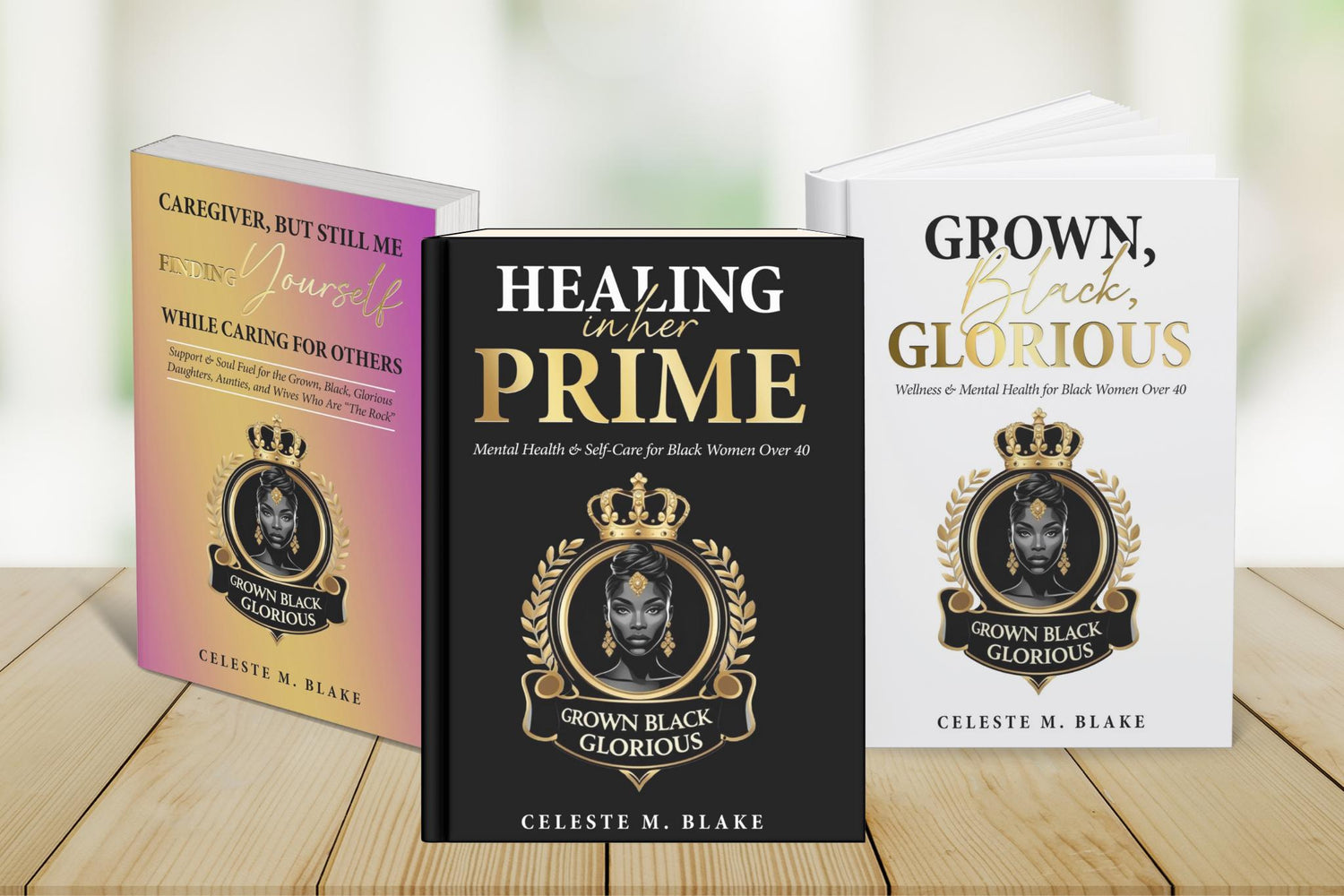
If you are caring for others while trying to hold onto yourself, the Caregiver But Still Me ebook was written for exactly this moment. And if you are ready to build a self-care practice that actually accounts for the weight you are carrying, the Self-Care Journal Bundle for Black Women 40+ is a structured, intentional place to begin. Not another thing to manage. A space that exists entirely for you.
You have been keeping track of everything for a very long time. It is time for something to keep track of you.
A Note Before You Go, Sis
This space was built with love, intention, and you in mind. Everything shared here, the reflections, the tools, the practices, the stories, is offered for educational and inspirational purposes only. It is not medical advice, psychological treatment, psychiatric care, or therapy, and it is not intended to replace any of those things.
I am not a licensed mental health professional, medical doctor, psychologist, psychiatrist, or therapist. Nothing on this site creates a professional relationship between us, and nothing here should be treated as a clinical assessment, diagnosis, or treatment plan for any condition.
If you are moving through severe emotional pain or carrying trauma that feels too heavy to hold, you deserve more than words on a screen. You deserve a trained professional in your corner, someone who can see you fully and care for you personally. Please reach out to a qualified mental health or medical provider. That is not a detour from your healing. That is the healing.
By engaging with this content, you agree that it is provided for informational and inspirational purposes only. You take full responsibility for how you engage with and apply what you find here, and for seeking professional clinical care when your situation requires it.
You are not alone. And you are worth every resource available to you, including the professional ones. 💜
Your story continues...
---
**Welcome home to yourself, beloved.**

With warmth and faith in your journey,