

There is a particular kind of exhaustion that does not show up on any lab report. It is not iron deficiency. It is not thyroid levels. It is the bone-deep tiredness of a woman who has said yes her entire life, not because she wanted to, but because she never believed she was allowed to say anything else.
Setting boundaries and emotional healing for Black women are not separate conversations. They are the same one. And this is not a post about stopping the care. It is not about closing yourself off or becoming someone who withholds love. The women in our families who gave everything, they were not wrong to love deeply. They were wrong to leave themselves out of it. What we are talking about here is a different kind of strength. Not the strength that endures in silence. The strength that has the courage to say no when no is necessary, the wisdom to prioritize her own restoration so she actually has something real to give, and the grace to pour love into others without ever abandoning herself in the process. That is the strength we are building here.
And if you are over 40 and still bracing yourself every time someone asks you for something, still rehearsing apologies before you have even declined, still feeling guilty about protecting your own energy, this post is written specifically for you.
Why Black Women Are Conditioned to Say Yes at Their Own Expense
Nobody sat us down and said you are not allowed to have limits. But the message came through anyway.
It came through every time we watched the women in our families hold everything together without ever asking for help. It came through in church, in school, in every space that praised us for being strong and dependable and good. We learned early that our value was tied to what we could do for others. That saying no was a kind of betrayal.
And this is not just a Black American story. This is a diasporic story. A global one.
In Haiti, the woman who sacrifices everything is not just admired, she is expected. The manman (mother) who works herself into the ground, who sends money back home, who never complains, who feeds everyone before she feeds herself. Her suffering is framed as devotion. Her exhaustion is called love. There is no language in that framework for a woman who says: I cannot do this today.
In Nigeria, the concept of being a good woman is deeply tied to service, to your husband, your in-laws, your community. Women who push back are described as difficult, as too Western, as forgetting where they come from. The pressure is not just social. It is ancestral. You are not just disappointing one person. You are allegedly dishonoring a lineage.
In Jamaica, the strong Black woman is practically mythology. She is Miss Lou carrying the culture. She is the grandmother who raised twelve children on nothing and still made Sunday dinner. That image is beautiful, and it is also a cage. Because when strength is your identity, asking for help, or simply saying no, feels like a confession of failure.
In the United Kingdom, Black British women of Caribbean and West African descent describe a particular double bind: navigating white professional spaces where they must not be too loud or too much, while simultaneously managing family and community expectations that they be endlessly available. You code-switch your whole personality at work, then come home and are expected to show up fully for everyone else. There is no room in that schedule for your own needs.
Black women and boundaries healing is a newer phrase, but the wound it describes is not new at all. Across cultures, across continents, the expectation that Black women would simply absorb, the labor, the emotional weight, the needs of everyone around them — is not accidental. It was built. And we inherited it.
By the time many of us hit 40, we have been saying yes for so long that we do not even recognize the cost anymore. It just feels like life. It feels like who we are.
But it is not who you are. It is what you were trained to do.
What Happens to the Body and Mind When You Never Say No
Here is what I want you to understand: saying no as a Black woman is not just a communication skill. It is a survival skill. Because what happens when you do not use it is real, and it is physical.
Chronic people-pleasing keeps your nervous system in a low-grade state of threat. You are always monitoring. Always anticipating. Always managing the emotional climate of every room you walk into. That vigilance is exhausting in ways that sleep does not fix.
The stories shared in this section are composites drawn from common lived experiences across the diaspora. They are illustrative and fictional. Any resemblance to specific individuals is coincidental.
Consider the Ghanaian woman in her mid-40s who has been sending remittances home for twenty years. School fees. Hospital bills. Funeral costs. She does not talk about the fact that she is drowning too. In her family, her success was never really hers alone, it belonged to everyone who sacrificed to get her here. So she keeps sending. She keeps managing. And nobody thinks to ask if she is okay because she has never once looked like she was not.
The Afro-Latina woman grew up watching her mother and her grandmother move through the world as though their own needs were a minor inconvenience. Marianismo did not arrive with a name or a label. It just arrived as example after example of what a good woman looked like, quietly enduring, spiritually devoted, never complaining, always holding. By the time she is in her 40s she has become that woman so completely that she genuinely cannot tell the difference between who she chose to be and who she was shaped into.
And then there is the Black South African woman who has heard ubuntu her whole life and believed in it, because at its core it is beautiful. Community. Interdependence. The idea that we rise together. But there is a version of ubuntu that gets used against women specifically. Where I am because we are quietly becomes your needs are not separate from ours, which quietly becomes your needs do not exist. She has felt that shift. She just never had words for it until now.
African American women carry something that does not always get named plainly. The pressure to be twice as good, to take up the right amount of space, to be strong without making anyone uncomfortable with how much that strength is costing you, that is not just a workplace dynamic. It followed her home. It followed her into her marriage, her friendships, her relationship with her own body. The strong Black woman was not just something people called her. It became something she called herself, and somewhere along the way it stopped feeling like pride and started feeling like a sentence.
Black Canadian women know a particular kind of invisibility. The country is polite about it, which almost makes it harder to name. You are welcome here, technically. You are included, on paper. But there is still the daily work of moving through spaces that were not designed with you in mind, adjusting, absorbing, staying composed because composure was the price you learned early for being taken seriously. It is not dramatic. It does not announce itself. It is just the low hum of having to be a little more careful, a little more measured, a little more patient than everyone else in the room. By her 40s that particular kind of careful can feel less like a strength and more like a habit she is exhausted by but does not quite know how to put down.
Over time, the inability to say no shows up as anxiety you cannot explain. It shows up as resentment that bubbles up at the wrong moments and catches you off guard. It shows up as a creeping numbness, a flatness where your enthusiasm used to be. A lot of women in their 40s chalk this up to aging or hormones. Sometimes it is. But sometimes it is the accumulated weight of a thousand swallowed nos.
There is also the grief piece, and this one tends to hit harder than people expect. When you have spent decades prioritizing everyone else, there comes a point where you realize you do not actually know what you want anymore. You have been so busy attending to other people's lives that yours has been living on the back burner. That is not a small loss. That is a profound one.
If you have ever wondered whether some of what you are carrying goes deeper than stress, the post 10 Signs You Are Carrying Emotional Wounds You Never Had Permission to Address might help you put language to what you have been feeling.
Are You Tired of Being the Strong One?
You do not have to white-knuckle your way through healing. The I Am So Tired of Being Strong workbook was written for the woman who has been carrying more than her share for longer than she can remember. Five pages. Honest prompts. A place to finally put some of it down.
Download your free 5-page healing workbook now, and finally put some of that weight down.
Download your free healing workbook here
How Saying No Becomes an Act of Emotional Healing
This is the part that most boundary-setting advice skips entirely. They give you scripts. They talk about self-respect and communication styles. What they do not tell you is what it means, emotionally, when you finally do it.
The first real no, not the polished one, the scared one, is an act of profound self-recognition. It says: I exist. My limits are real. My needs are not negotiable. And for a Black woman who has spent her life being praised for her selflessness, that moment can feel like stepping off a cliff. It is terrifying. It is also the beginning of something.
And here is what that beginning does not mean. It does not mean you stop being the woman who shows up for people. It does not mean you become unavailable or hard or closed. The goal was never to care less. The goal is to care from a place that is full instead of a place that is fracturing. A woman who has learned to say no when she needs to is not a woman who loves less. She is a woman who loves better, more honestly, more sustainably, more freely, because she is no longer giving from a wound. She is giving from a choice. That is not weakness dressed up as strength. That is actual strength. The kind that lasts.
The following scenarios are fictional composites created to illustrate shared patterns across the diaspora. They do not represent or refer to any real individuals.
There is a woman somewhere in Toronto, raised in a Trinidadian household where the older women cooked for every gathering, organized every family event, and were the last ones to sit down at their own table. She spent thirty years doing the same. The first time she told her family she would not be hosting Christmas that year, her hands were shaking. The silence on the phone was enormous. She thought she had broken something. What she had actually done was begin to heal it.
There is a woman in London, British-Jamaican, who spent years managing her elderly mother's care while working full time and raising her own children, with no help from her brothers because in their family, caring was women's work. The day she told them she needed them to step in, that she could not carry it alone anymore, felt like the most radical thing she had ever done. It was.
Setting boundaries and emotional healing for Black women are connected because boundaries are how you tell yourself the truth. Every time you say no to something that violates your energy or your values, you are reinforcing a belief that your internal experience matters. That is not just empowerment. That is repair.
The 7 stages of emotional healing every Black woman goes through include a stage that is often overlooked, the stage where you start to recognize your own needs as legitimate. Saying no is not something that comes after that stage. It is often what kicks it off.
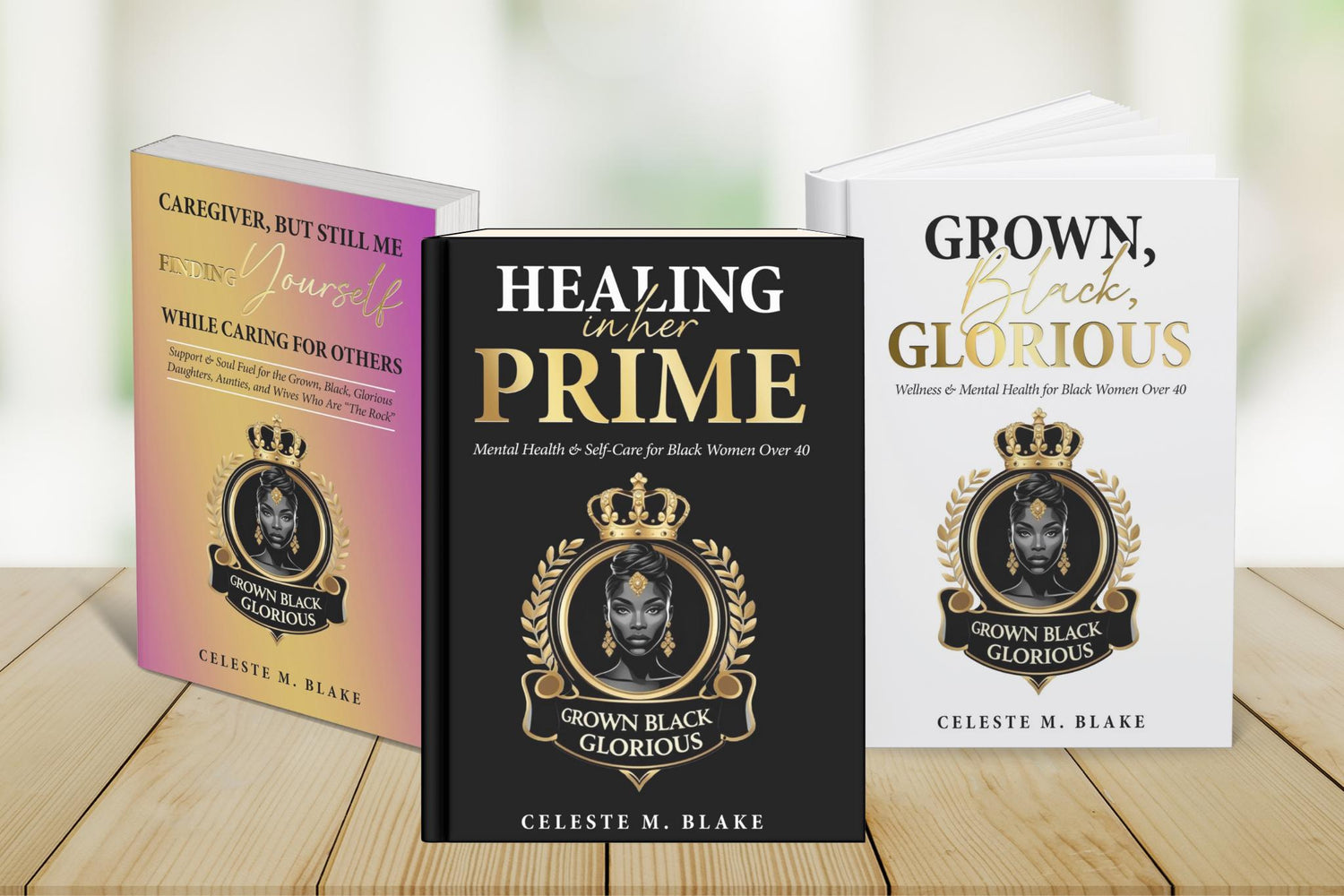
This is exactly the shift we walk through inside Healing in Her Prime, where boundaries stop being theory and become something you actually live.
The Specific Ways Boundaries Protect Your Healing Journey
Boundaries and emotional health for Black women are connected in some very specific, practical ways. This is not abstract.
When you do not have them, your healing cannot hold. You can do all the journaling, the therapy, the retreats, the self-care routines, but if you go right back into environments and dynamics that drain you without refueling, you will constantly feel like you are starting over. That is not failure. That is physics.
In many West African traditions, the concept of the community elder woman is deeply respected, but it also means her labor is taken as given. In Senegal, in Ghana, in Nigeria, older women are often the emotional infrastructure of entire extended families. Beautiful, yes. But also: who tends to them? Who asks if they are okay? Who gives them permission to rest? When a woman in that role begins to say no, to decline the role of permanent emotional first responder, it can feel like she is dismantling something sacred. She is not. She is finally becoming part of the community she has been holding.
In the Caribbean diaspora, there is a particular tension between the homeland definition of a good woman and what survival in a new country actually requires. The Barbadian grandmother in Brooklyn who worked three jobs and never asked for anything has been mythologized in her family. And her granddaughter, now in her 40s, is running the same pattern, even though the context has completely changed. What kept one generation alive is quietly depleting the next one.
Here is what boundaries actually do for your healing:
They stop the hemorrhage. You cannot pour back into yourself if there is a slow leak you are not addressing. Saying no is how you close the gap.
They create evidence. Every time you enforce a limit and survive it, every time you say no and the relationship does not collapse, the world does not end, people do not abandon you, you build a new internal record. That record becomes the foundation for trusting yourself.
They give your nervous system a chance to reset. When you are not constantly in anticipatory mode, bracing for the next demand, your body can begin to settle. Healing is not just emotional. It is physiological. Your body needs to feel safe to repair.
They clarify your relationships. Boundaries reveal which connections in your life are actually reciprocal. That information is painful sometimes. But it is clarifying in a way that serves your healing long term.
How to Start Saying No Without Guilt or Explanation
Nobody starts here. That is the first thing to understand. You are not going to wake up one day and suddenly be a person who declines things with ease. This is a practice, and it is messy at the beginning.
A few things that actually help:
Start with the small yeses you regret. You do not have to tackle the hardest relationships first. Start by noticing the small moments where you say yes and immediately feel a drop in your energy. The committee you joined out of obligation. The phone call you take even though you know it will leave you depleted. Those are your practice reps.
Give yourself permission to respond, not react. You do not have to answer immediately. Let me think about that and get back to you is a complete sentence. Buying yourself time removes the panic that makes you default to yes out of habit.
Drop the explanation habit. We have been trained to justify our nos, to soften them, to make them more palatable. But every explanation you attach is an implicit message that your no alone is not enough. A woman in Nairobi once described the hardest part of learning to say no as realizing she did not owe anyone a reason. She had spent 45 years believing she did. Sometimes it is just: no, that does not work for me. Full stop.
Expect the guilt, and do it anyway. The guilt is going to come. Especially at first. Especially if the people around you are used to you being available. That guilt is not a sign that you did something wrong. It is a sign that you are doing something new. Let it be there. Do it anyway.
Understand that emotional healing for Black women over 40 often requires unlearning things we were taught to see as virtues, across every culture, every country, every generation that handed us this particular inheritance. Being endlessly available was never actually a virtue. It was a survival mechanism that outlived its usefulness.
Somewhere right now, there is a Haitian woman, a Nigerian woman, a Jamaican woman, a Black British woman, a Brazilian woman, a South African woman, all carrying the same wound in different languages. All performing strength they stopped feeling years ago. All waiting for permission to put something down.
Here is what we believe at Grown Black Glorious: being a strong Black woman means having the courage to set boundaries even when it is uncomfortable. The wisdom to prioritize your own restoration so you can show up whole. And the grace to pour love into the people in your life without ever disappearing from your own. That is not a smaller life. That is a bigger one. One where you are actually in it.
You do not need permission. But if it helps to hear it: you are allowed to be in your own life. You always were.
Healing in Her Prime includes a full section on boundaries as healing, because your no is your first act of self-recovery. Your healing does not start after you figure everything out. It starts the moment you decide your needs are worth protecting.
A Note Before You Go, Sis
This space was created with care, intention, and deep respect for the experiences many Black women carry. The reflections, stories, and tools shared here are offered for educational and inspirational purposes only.
They are not medical advice, psychological treatment, psychiatric care, or therapy, and they are not intended to replace the guidance of licensed professionals.
I am not a licensed medical provider, therapist, psychologist, psychiatrist, or mental health professional. The content on this site is meant to support reflection and personal growth, but it should not be used as a substitute for professional evaluation, diagnosis, or treatment.
If you are experiencing severe emotional distress, trauma, or mental health challenges, reaching out to a qualified healthcare or mental health professional is an important and supportive step. Professional care is not separate from healing, it is often a powerful part of it.
By engaging with this content, you acknowledge that it is shared for informational and inspirational purposes and that personal decisions about health, wellbeing, and care should always be made with the support of appropriate professionals when needed.
You deserve compassion, support, and every resource available to help you heal and grow.
---

With warmth and faith in your journey,